Assignment
Select any passage to ask a question about it or to propose replacement wording.
Assignment
Part of Nidus Ontology V3 · Relationship Map
Definition
An Assignment is a directed operational action: one piece of work given to a Technician at a place, with a purpose and a kind. It is the unit through which work is carried out, and it records what the work was, who did it, and when.
Ontological Position
An operational object, and an event rather than a plan. It carries both halves of a visit: the instruction that sends a Technician to a place to do a particular kind of work, and the account of what that Technician found and did. Intent and result live in one record, and the result is what the rest of the model reads.
A Lead and a Work Order say what should be investigated or done; an Assignment turns that into a visit and reports back what happened. The records it produces — Observations, Inspections, and Treatments — are what change what is known about a Feature.
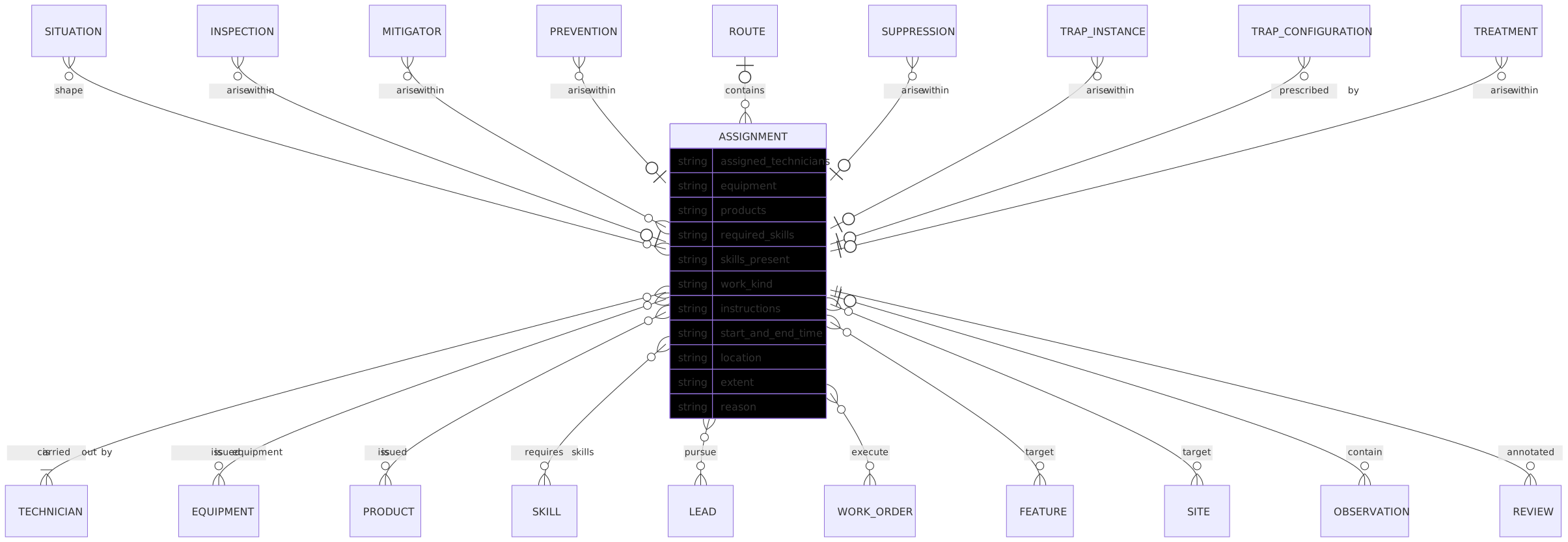
- An Assignment is carried out by one or more Technicians (Technician |{──o{ Assignment).
- An Assignment is issued the equipment the work requires (Assignment }o──o{ Equipment).
- An Assignment is issued the specific Products the work calls for (Assignment }o──o{ Product).
- An Assignment requires the skills the work needs, inherited from its Work Order where one exists (Assignment }o──o{ Skill).
- An Assignment may pursue one or more Leads (Assignment }o──o{ Lead).
- An Assignment may execute one or more Work Orders (Work Order }o──o{ Assignment).
- An Assignment may target one or more Features (Assignment }o──o{ Feature).
- An Assignment may target Sites for survey work (Assignment }o──o{ Site).
- An Assignment may contain Observations (Assignment o|──o{ Observation).
- An Assignment may raise Work Orders for work found in the field (Assignment }o──o{ Work Order).
- A Situation may shape an Assignment's parameters: who goes, with what Product and Equipment, to do which work (Situation }o──o{ Assignment).
- An Assignment may be annotated by Reviews (Assignment ||──o{ Review).
Properties
Who/What
- Assigned Technicians — the one or more Technicians responsible for carrying out the work. At least one, and more where the job needs more than one pair of hands.
- Equipment — the equipment issued for the work, recorded on the Assignment so that what was used can be traced to the work it supported.
- Products — the specific Products issued for the work, so that what was applied traces to the work it was applied under.
- Required Skills — the skills the work demands, taken from the Work Order where the work came from one.
- Skills Present — whether the assigned Technicians held the required skills when the work was assigned. Values: Present, Absent.
Work
- Work Kind — what the work is:
set_trap,collect_trap,inspect,abate,treat, orcustom. The set is closed because each kind accepts different evidence of completion. - Instructions — what to do, required for a
customAssignment. - Start and end time — when the work happened.
Reach
- Location — where the work is to be done.
- Extent — how far it reaches. By default the union of the extents of the Leads and Work Orders it comes from.
Origin
- Reason — why the work was done, recorded when the Assignment came from no Lead and no Work Order.
Rules
- An Assignment states both intent and result. It tells the Technician where to go and what to do, and it records where they went and what they did.
- An Assignment may arise from a Lead or a Work Order, or directly when work happens outside planning. A direct Assignment is permitted and records its reason; it is discouraged, because nothing in the record closes the loop it opens.
- Work Kind is a property of the Assignment. Completion evidence differs by kind, so the kind is what tells a completion record which evidence to look for.
- A
customAssignment must carry instructions, since nothing else states what the work was. - Where an Assignment arises from Leads or Work Orders, its location and extent default to their union. A visit that covers less or more records what it actually covered.
- Closure is final. A completed or cancelled Assignment is not reopened; later work is a new Assignment, and an error in the record is corrected through Review with the reason stated.
- Skills are properties of Technicians. An Assignment records the skills its work requires and whether the assigned Technicians held them, so a shortage is visible where it happened.
- A Situation sets parameters; an Assignment records the visit. Situation guidance may determine who goes, what Product and Equipment are issued, and which work is done, and the Assignment reports what those parameters produced.
Relations
Every relation this concept takes part in is drawn on the relationship map.