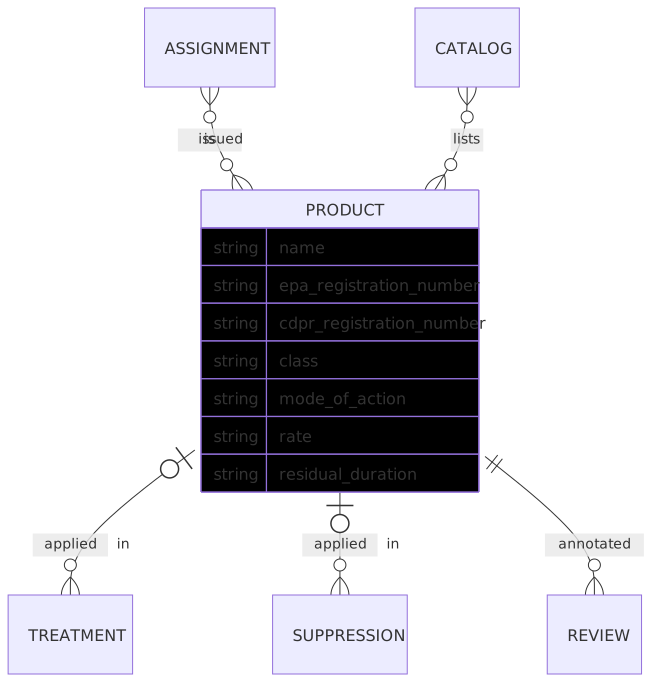
Product
Select any passage to ask a question about it or to propose replacement wording.
Product
Part of Nidus Ontology V3 · Relationship Map
Definition
A Product is a control material the district applies in an intervention to reduce or eliminate mosquito production: a larvicide, a biological control agent, or another containment substance. The district names it, and the record carries what that material is, how it acts, the rate it is applied at, and how long it keeps working.
Ontological Position
An informational object, and a district-configured reference rather than an action. A Product has no place and no time of its own: it is applied somewhere at some point by a Treatment or a Suppression, and those records say where and when.
A Product carries the properties of the material, and other records read them from it. Its class — chemical or biological — and its mode of action belong here, so a Treatment states what it applied and never claims a class or a mechanism of its own. Its residual duration belongs here too, which is what makes the control window of a treated Feature a consequence of the product rather than a separate claim.
- A Product may be applied in one or more Treatments (Product o|──o{ Treatment).
- A Product may be applied in one or more Suppressions (Product o|──o{ Suppression).
- A Product may be issued for an Assignment (Assignment }o──o{ Product).
- A Product may be annotated by Reviews (Product ||──o{ Review).
Properties
Identity
- Name — the district's name or code for the product.
- EPA registration number — the federal registration number the product is registered under.
- CDPR registration number — the California registration number issued by the Department of Pesticide Regulation, where the product is registered in the state.
What it is
- Class — the kind of agent. Values: Chemical, Biological.
- Mode of action — how the agent acts: gut toxin, neurotoxin, insect growth regulator, suffocation, or whatever the label states.
Application
- Rate — the prescribed application rate, a range on most products.
- Residual duration — the period the product keeps suppressing production at the treated Feature, where the product has one.
Rules
- The product list is district-configured. The set of products is data, and it varies by district.
- Products retire rather than disappear. A retired product keeps its meaning in every record that names it.
- Class and mode of action belong to the Product. A Treatment records what was applied and reads these from the Product.
- Residual duration is carried only on the Product. A Treatment carries none of its own.
- A Feature's control window derives from the residual duration of the Product applied. A product with no defined residual duration cannot produce a Controlled Feature.
- Rate is the label's prescribed application rate, and a range on most products. The applied rate is the Treatment's quantity over the area treated, and that is what the label rate is compared against.
- A Product and a Treatment's method are distinct. A product name never stands in for a method, and a method never stands in for a product.
Relations
Every relation this concept takes part in is drawn on the relationship map.