Pool
Select any passage to ask a question about it or to propose replacement wording.
Pool
Part of Nidus Ontology V3 · Relationship Map
Definition
A Pool is a group of specimens drawn from exactly one Trap Sample, of a single species and sex, submitted for testing. It is what the laboratory tests for a pathogen or another target, and its results are stored with the Pool Tests.
Ontological Position
A real-world entity: the grouped specimens themselves, recognized and represented once they are set aside for testing.
A Pool carries its composition and none of its results. Positivity is a set rather than a scalar, because several tests run on one Pool at the same time and a Pool may be positive for more than one target at once. Each result lives on the test that produced it, and a Pool's standing is the standing of its tests taken together.
Because a Pool draws from one sample, every result it produces is fully attributable: a species, a sex, a place, and a span of time, all reached through the sample.
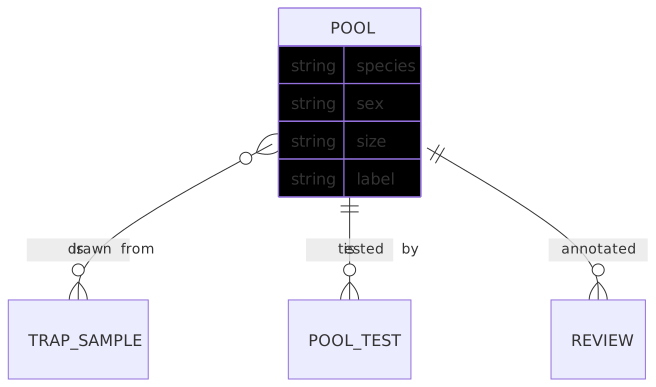
- A Pool is drawn from exactly one Trap Sample (Trap Sample }o──o{ Pool).
- A Pool is decomposed into one or more Pool Tests (Pool ||──o{ Pool Test).
- A Pool may be annotated by Reviews (Pool ||──o{ Review).
Properties
Composition
- Species — the single species the Pool holds.
- Sex — the sex of the specimens pooled.
- Size — how many specimens the Pool holds.
Identity
- Label — the marking that identifies the Pool to the laboratory.
Rules
- A Pool draws from one Trap Sample and never from two, and it holds one species and one sex. Pooling across samples or species is outside the model.
- A Pool's result is attributable to a species, a sex, a place, and a span of time, and every one of them is reached through the sample it came from.
- The district and the laboratory decide pool composition. Partial pools, retained remainders, and redistribution into equal sizes are their choices, and any submitted composition is accepted.
- Conservation is the one constraint, scoped to species and sex: the specimens pooled for a species and sex may not exceed the Species Count for that species and sex in the sample. Exceeding it means a data error elsewhere in the chain.
- That bound runs one way only. The completeness of pooling is not validated, so how much of a sample was tested is read from the Pools and never assumed.
- Positivity belongs to the tests. A Pool states which specimens it holds, and its tests state what was found in them.
Relations
Every relation this concept takes part in is drawn on the relationship map.