Trap Station
Select any passage to ask a question about it or to propose replacement wording.
Trap Station
Part of Nidus Ontology V3 · Relationship Map
Definition
A Trap Station is an established location at which traps are set consistently over time. It is a district decision about where trapping happens, the reference a Trap Instance is set against, and the identity a trapping series is attributed to.
Ontological Position
An informational object, and a reference record rather than a thing found in the field. The district creates a station at planning time; nothing out there answers to it. It records a place with a coordinate and a Site, and it executes no action of its own.
A station states permission as well as position. Trapping at a location is a privilege the district holds from the owner, and the privilege attaches to the Site through its Contacts. A station whose Site records no consent authority is a station awaiting permission, and it stays a valid record of a place until the Site's standing changes.
A station is a location and nothing more. The act belongs to the Trap Instance, the hardware to Equipment. One station hosts any number of instances and owns no equipment.
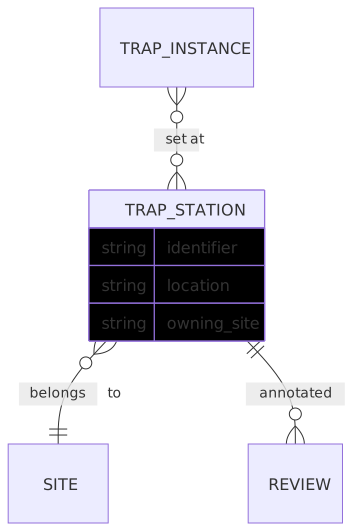
- A Trap Station belongs to exactly one Site (Site ||──o{ Trap Station).
- A Trap Station may host zero or more Trap Instances (Trap Station }o──o{ Trap Instance).
- A Trap Station may host any Trap Configuration, and two Configurations at one station are two series.
- A Trap Station may be annotated by Reviews (Trap Station ||──o{ Review).
Properties
Identity
- Identifier — the only thing that identifies a station.
Location
- Location — the coordinates the station designates.
Permission
- Owning Site — the Site whose consent governs trapping at the station.
Rules
- A Trap Station never moves. A change of place is a new Trap Station, and the earlier one keeps the place it named.
- A correction that moves the location materially — of the order of 50 metres — warns that it risks corrupting the series and recommends a new station. It warns and never blocks.
- A Trap Instance associates to a station when it falls within range of it — of the order of 5 metres. Beyond that range the instance is off-station and forms no series.
- Trap Stations are created by the district at planning time, and a trap being set does not create one.
- A station expresses permission to trap at a location. The permission attaches to the owning Site through its Contacts, and never to the station.
- A station whose Site no longer carries consent is retired. The history of where traps were set stands as recorded.
- A station is never deleted but can be made inactive.
Relations
Every relation this concept takes part in is drawn on the relationship map.