Observation
Select any passage to ask a question about it or to propose replacement wording.
Observation
Part of Nidus Ontology V3 · Glossary entry · Relationship Map
Definition
An Observation is a fact established in the field by a Technician about a Site, a Feature, or a Facilitator, through direct interaction with the thing observed. It records what was found at that place and at that time, and it is the evidence a Feature or Facilitator record rests on. Confirmed absence is an Observation: finding no standing water in a pool is as much a finding as finding water in it.
Ontological Position
An informational object, not a thing in the world. A Feature or a Facilitator exists whether or not Nidus represents it; an Observation exists only as the record of what a Technician established, so it carries the time, the place, and the person without which the finding cannot be understood.
An Observation establishes what was found: classification, condition, water presence, and the type and presence of a condition. Production is established by Inspection, and a Feature found Dry is already the answer, because Dry is Not producing. Control is established by Treatment.
An Observation is direct. Material gathered without access to the subject — a photograph taken over a fence, imagery from a drone, a resident's report — is not an Observation. Such material supports a Signal until a Technician observes the subject directly.
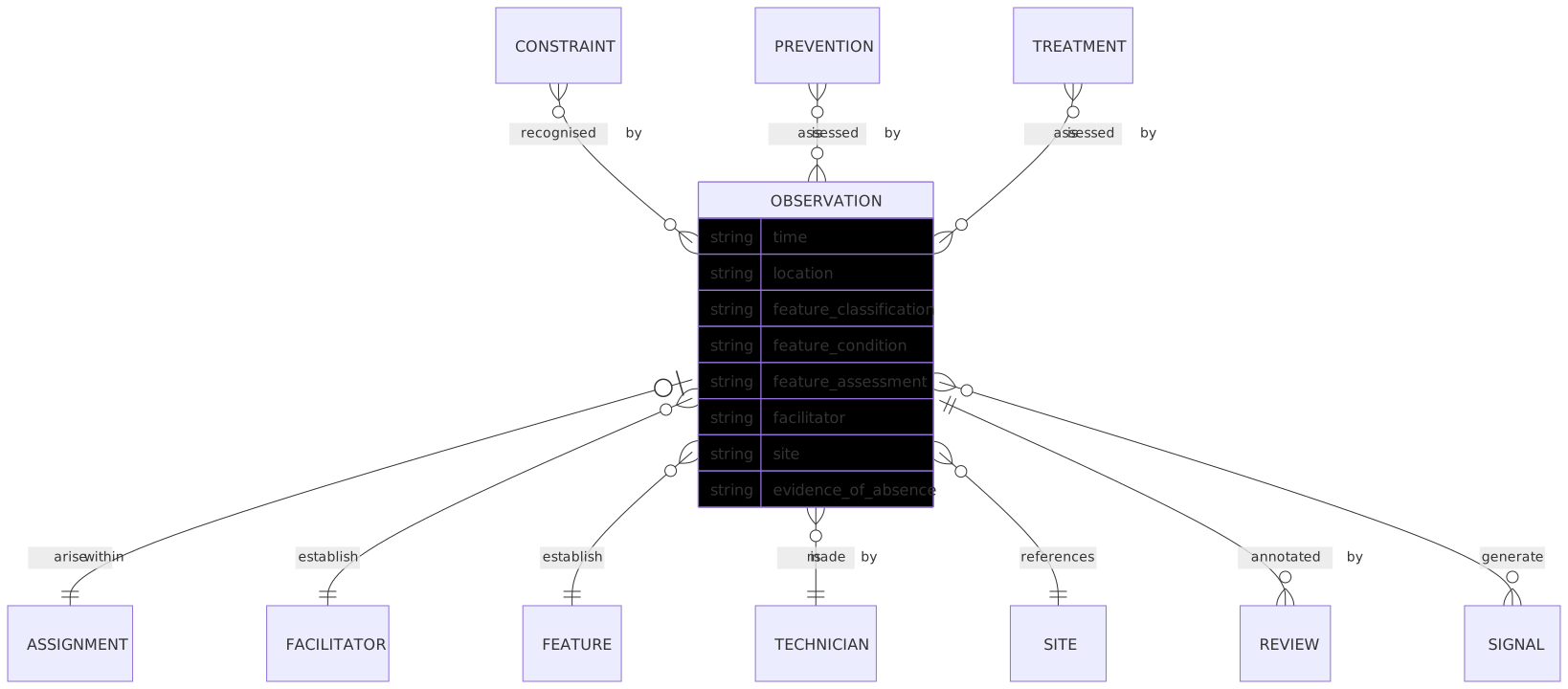
- An Observation is made by exactly one Technician (Technician ||──o{ Observation).
- An Observation references exactly one Site, Feature, or Facilitator (Site ||──o{ Observation; Feature ||──o{ Observation; Facilitator ||──o{ Observation).
- An Observation may arise within an Assignment (Assignment ||──o| Observation).
- An Observation may be annotated by Reviews (Observation ||──o{ Review).
Properties
An Observation carries what the Technician established about the values examined, not a copy of the subject's full state.
Provenance
- Time — when the Observation was made.
- Location — where at the Site it was made.
Content
- Feature — classification — Habitat, Water Origin.
- Feature — condition — Size, Organic Content, Flow State, Water Connectivity, Vegetation Influence.
- Feature — assessment — Water Presence.
- Facilitator — Facilitator Type, Location, Affected Feature.
- Site — conditions of the Site itself, such as occupancy, access, and the absence of a Feature expected there.
- Evidence of absence — the confirmed absence of an expected Feature or Facilitator at the Site.
Rules
- An Observation is made at the Site by a Technician in direct interaction with the subject. Proximity is the test: the Technician must be close enough to establish the fact directly, and material gathered without access to the subject is not an Observation.
- An Observation is made by a member of the organization acting as Technician. Resident reports, public photographs, and other outside input are Communication artifacts and may raise Signals; they are not Observations.
- An Observation references exactly one Site, Feature, or Facilitator and states what was found there, including confirmed absence.
- An Observation may arise within an Assignment but never requires one. The link is recorded where the work was planned; no Assignment is created to hold an Observation.
- An Observation is fixed to the time it was made. Later understanding is expressed as a new Observation, and the earlier record continues to state what was found then.
Relations
Every relation this concept takes part in is drawn on the relationship map.