Trap Sample
Select any passage to ask a question about it or to propose replacement wording.
Trap Sample
Part of Nidus Ontology V3 · Relationship Map
Definition
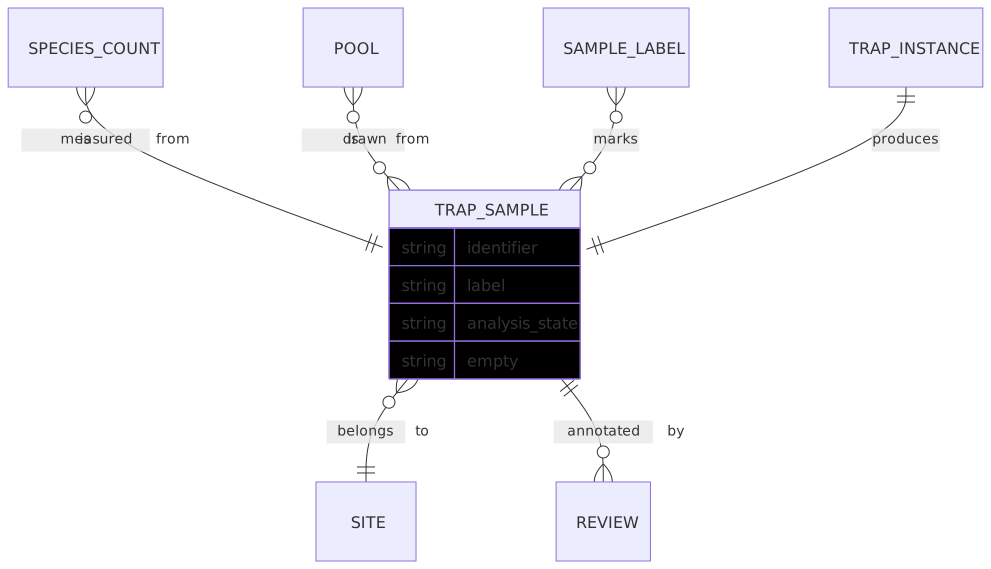
A Trap Sample is the physical sample produced by a Trap Instance: the adult specimens one trap collected at one place over one interval. It carries its own identity and label, and its composition appears once the lab has analyzed it.
Ontological Position
A real-world entity, recognized and represented: a bag or vial of specimens that exists whether or not the lab has opened it. The trap is the method by which it was obtained, and the Trap Instance is the act that obtained it.
A Trap Sample holds no account of its own context. Location and trap configuration are read through the instance, so a correction to either cannot leave two copies drifting apart.
Analysis is a later event on the same sample. Collection creates the sample with its composition unknown, and analysis establishes the composition as Species Counts.
- A Trap Sample is produced by exactly one Trap Instance (Trap Instance ||──|| Trap Sample).
- A Trap Sample belongs to exactly one Site (Site ||──o{ Trap Sample).
- A Trap Sample is decomposed into zero or more Species Counts (Trap Sample ||──o{ Species Count).
- A Trap Sample may yield zero or more Pools (Trap Sample }o──o{ Pool).
- A Trap Sample may be annotated by Reviews (Trap Sample ||──o{ Review).
Properties
Identity
- Identifier — the only thing that identifies a sample.
- Label — the marking the field crew and the lab use to refer to it.
Analysis
- Analysis state — whether the composition is known. Values: Unanalyzed, Analyzed.
- Empty — whether an analyzed sample held no specimens. Values: Yes, No.
Rules
- A Trap Sample requires no Assignment. Collection is enough, and the sample stands on its own.
- The Technician is never a Trap Sample property. The people who set and collected the trap are recorded on the Trap Instance that produced the sample.
- A Trap Sample exists before its composition is known. Collection creates it, and analysis is what establishes what it contains.
- An analyzed sample records whether it was empty. Empty states that analysis happened and found no specimens, and it is what establishes a zero for every species. In a sample that is not empty, a species' absence is the inverse of its counts.
- Metrics are computed from Species Counts. A sample reaches them through the counts it produced, and an unanalyzed sample has none, so its catch is never treated as zero.
- A sample produced by a Trap Instance flagged with a trap problem contributes no counts to metric calculations. The sample and its record are kept.
- Absence reaches the metrics as the denominator. A species average is denominated by the samples in which that species could have been caught.
- Context travels, it is never copied. Location, configuration, and interval are read from the instance that produced the sample.
- Comparability is a judgement made from the record. A sample carries the detail it takes to judge it — its configuration, its set and collect times, and its location — and the analyst decides which samples compare.
- Analysis is a single transition on the sample. Composition is unknown until it is analyzed, and it is known from then on.
Relations
Every relation this concept takes part in is drawn on the relationship map.