Situation
Select any passage to ask a question about it or to propose replacement wording.
Situation
Part of Nidus Ontology V3 · Relationship Map
Definition
A Situation is the district's reading of conditions for a defined scope, together with the operational guidance that follows from it: what should be done, and at what intensity. It is established by interpreting Signals against the district's aims and its own situation rules, and it sits between that interpretation and the planning of work — broader than a Lead, less concrete than an Assignment. It influences how Leads are prioritized, which methods are available, what resources are committed, and how coordination and communication are scaled.
Ontological Position
An informational object, and the district's own construction rather than a fact about the world. The ontology supplies the structure — a scope, the rules tested against Signals, and the outcomes those rules direct. The district supplies the conditions and what each outcome means.
A Situation is an interpretation, not a deduction. The same Signals can support different Situations under different district aims, which is why establishing one for a given area is a human act.
A Situation mutates nothing it reads. It does not create, close, or alter Signals, Leads, Features, Assignments, or Treatments; it informs the decisions that do.
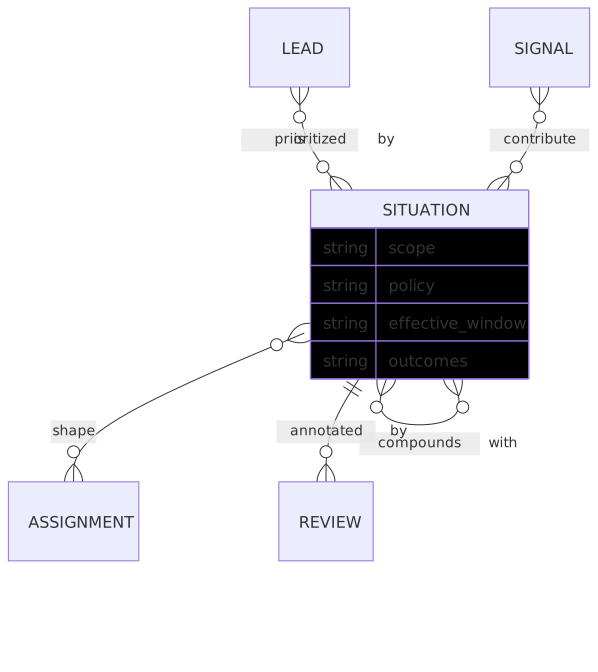
- A Situation is interpreted from one or more Signals, or from a baseline or absence defined by district policy (Signal }o──o{ Situation).
- A Situation applies to one area at one scope, and may compound with other Situations assessed over the same area (Situation }o──o{ Situation).
- A Situation may influence the priority of Leads (Situation }o──o{ Lead).
- A Situation may be annotated by Reviews (Situation ||──o{ Review).
Properties
Assessment
- Scope — the dimension the Situation is assessed over: species, operational domain, geography, signal source, or another district-defined dimension. Omitted for a district-wide Situation.
- Policy — the district rule set the Situation is established under, by version.
- Effective window — the time over which the Situation's guidance applies.
Guidance
- Outcomes — what the matching rule directs: lead priority, authorized methods, surveillance and inspection intensity, resource commitment, coordination and communication requirements, and decision authority.
Rules
- A Situation is interpreted, not determined. Signals supply conditions; district aims and rules supply their meaning, and an authorized person establishes the Situation for the area.
- A Situation changes nothing it reads. It may recommend Leads, Assignments, or Communications, and each of those retains its own creation and approval rules.
- Scope is one dimension of assessment. Several Situations may be active over the same area in different scopes, and their guidance compounds for the operator.
- Signals alone do not make a Situation. A Situation may rest on an explicit baseline or an absence defined by policy.
- Guidance is not a claim about the world. A baseline or suppressive reading does not assert that production is absent, and no Situation outcome substitutes for direct establishment.
Relations
Every relation this concept takes part in is drawn on the relationship map.