Equipment
Select any passage to ask a question about it or to propose replacement wording.
Equipment
Part of Nidus Ontology V3 · Relationship Map
Definition
An Equipment is a durable item the district owns and issues to carry out work: a truck, a vessel, a drone, a backpack sprayer, a dipper, a pair of waders, a mosquito trap. It has identity in the district's inventory, it serves many pieces of work, and it outlasts all of them.
Ontological Position
A real-world entity. Equipment is a tool the district brings to the work. Equipment persists, and what changes is its condition and where it is.
Equipment is tracked for two reasons: work depends on having it, and inventory must know where each item is and who is answerable for it.
Trapping hardware is Equipment on the same terms as any other district item. The trap type an item is built as is fixed for its life; how that trap is set on a given visit is a Trap Configuration, and the items actually deployed are recorded on the Trap Instance.
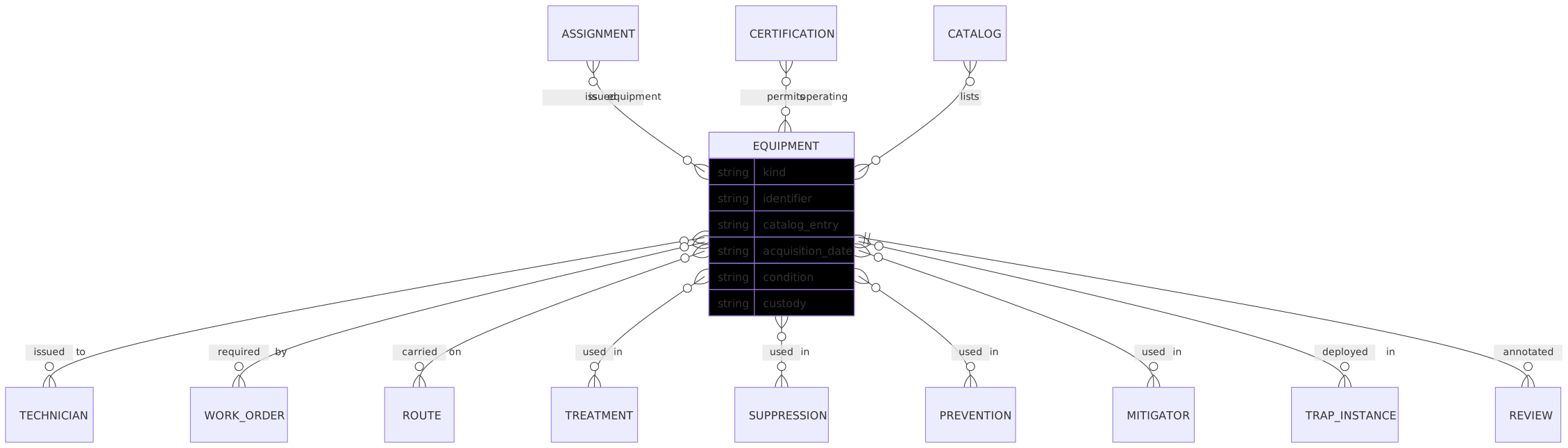
- Equipment may be issued to a Technician accountable for it (Technician }o──o{ Equipment).
- Equipment may be required by a Work Order (Work Order }o──o{ Equipment).
- Equipment may be issued for an Assignment (Assignment }o──o{ Equipment).
- Equipment may be carried on a Route (Route }o──o{ Equipment).
- Equipment may be used in a Treatment (Treatment }o──o{ Equipment).
- Equipment may be used in a Suppression (Suppression }o──o{ Equipment).
- Equipment may be used in a Prevention (Prevention }o──o{ Equipment).
- Equipment may be used in a Mitigator (Mitigator }o──o{ Equipment).
- Equipment may be deployed in a Trap Instance (Trap Instance }o──o{ Equipment).
- Equipment may require a Certification to operate (Equipment }o──o{ Certification).
- Equipment may be listed in a Catalog (Equipment }o──o{ Catalog).
- Equipment may be annotated by Reviews (Equipment ||──o{ Review).
Properties
Identity
- Kind — the class the item belongs to, taken from Equipment Kind.
- Identifier — the inventory label or serial that distinguishes this unit from another of the same kind.
- Catalog entry — the entry in a Catalog the item is built as, giving it one identity shared across districts. Fixed for the item's life.
- Acquisition date — when the district took the item into inventory, where known.
Condition
- Condition — where the item stands. Values: In service, In repair, Out of service, Lost, Retired. An item in repair is expected back; an item lost may be recovered and returned to In service; a retired item has left service for good.
- Custody — where the item currently is: held by a Technician, issued for an Assignment, or in the district pool.
Rules
- Two items of the same kind are two Equipment. A dipper is not interchangeable with another dipper once one has been issued and used.
- Equipment is not consumed. Work uses it and returns it, and its condition and custody are what change.
- Custody carries accountability. An item issued to a Technician stays with them across assignments and seasons; an item issued for one Assignment returns when that work ends.
- Equipment requiring certified operation may be used only by a Technician whose certification is valid at the time.
- Equipment keeps its identity for life. A retired or lost item is never deleted and its identifier is never reused, so the work that used it stays traceable.
- Items sharing a catalog entry are interchangeable. Where a configuration calls for an entry, any item of that entry may be deployed, and the instance records which one was.
Relations
Every relation this concept takes part in is drawn on the relationship map.