Species Count
Select any passage to ask a question about it or to propose replacement wording.
Species Count
Part of Nidus Ontology V3 · Relationship Map
Definition
A Species Count is the number of specimens of one species and sex found in a Trap Sample. It is a measurement produced by analysing a collected sample, and it exists only where that analysis has happened.
Ontological Position
An informational object: a measurement, not a thing in the world and not a field finding. A Signal may be raised from counts because a count is data about what was caught; the count itself is not an interpretation of anything.
The count takes its time and place from the Trap Sample it comes from. Trap configuration and interval belong to the sample and its instance, so a count never carries a second copy of them.
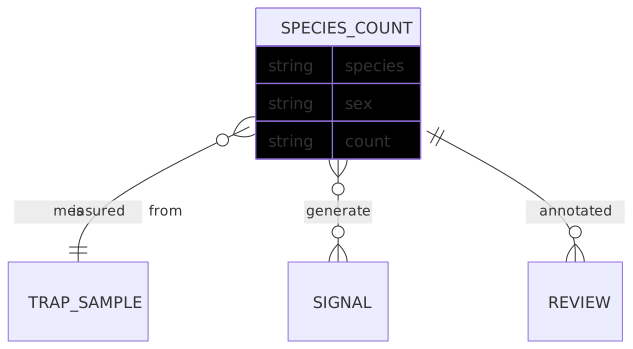
- A Species Count is measured from exactly one Trap Sample (Trap Sample ||──o{ Species Count).
- A Species Count may generate one or more Signals (Species Count }o──o{ Signal).
- A Species Count may be annotated by Reviews (Species Count ||──o{ Review).
Properties
Identification — what was counted.
- Species — the species identified in the sample, from the district's controlled vocabulary.
- Sex — male or female, and physiological state where the source distinguishes it.
Measurement — how much was found.
- Count — the number of specimens of that species and sex in the sample.
Rules
- A Species Count measures a sample. Nothing is counted before the sample is analysed, and a sample whose contents are unknown yields no count.
- No zero rows are written. A species not found has no count, and its zero is derived: from the sample's Empty flag where the sample held no specimens, and from the absence of a row where it was analyzed and was not empty.
- A count measures what a particular method caught. The trap configuration and interval are read from the sample and its instance, and the analyst decides which counts compare.
Relations
Every relation this concept takes part in is drawn on the relationship map.