Constraint
Select any passage to ask a question about it or to propose replacement wording.
Constraint
Part of Nidus Ontology V3 · Glossary entry · Relationship Map
Definition
A Constraint is a condition at a Site that obstructs work. It limits, delays, or prevents lawful physical access to the property or to a Feature on it, or it puts the Technicians, the public, or property at risk during reconnaissance, inspection, treatment, or prevention. A locked gate, a refused entry, an unstable bank, and a confined space are all Constraints.
Ontological Position
A real-world condition, represented rather than created by Nidus. The gate is locked, the dog is in the yard, and the bank is undercut whether or not the district holds a record of any of them. What Nidus holds is the recognition of the condition, which arrives two ways: a Technician meets it on scene, or a Contact states it in a Communication. A resident who refuses entry over the phone records the condition as surely as a Technician who finds the gate chained.
Constraints block progress at a site until they are eliminated or mitigated against.
A Constraint belongs to the Site. Each record states the condition as one visit met it. The influence of a Constraint persists in Site Interests as a warning to future Technicians to be aware of the condition and prepared to mitigate against it.
Where the condition blocks a particular Feature, that Feature is named as well. The Site is named in every case.
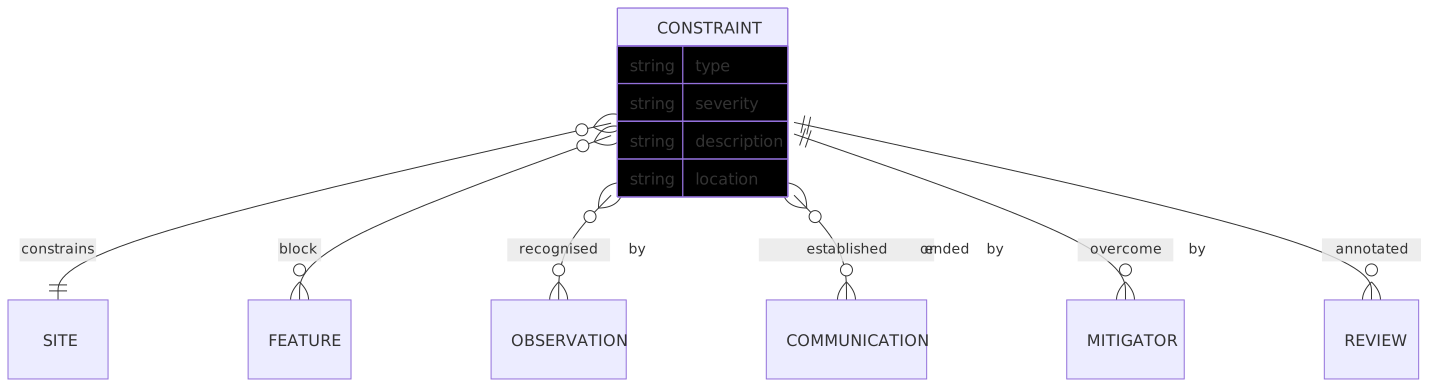
- A Constraint constrains exactly one Site (Site ||──o{ Constraint).
- A Constraint may block one or more Features (Feature }o──o{ Constraint).
- A Constraint may be recognised by Observations made in the field (Observation }o──o{ Constraint).
- A Constraint may be established or ended by a Communication, where a Contact grants or refuses access or states the condition (Communication }o──o{ Constraint).
- A Constraint may be overcome by one or more Mitigators (Constraint ||──o{ Mitigator).
- A Constraint may be annotated by Reviews (Constraint ||──o{ Review).
Properties
Character
- Type — the form the condition takes, taken from Constraint Type.
- Severity — how much harm the condition threatens. Values: Low, Moderate, High. Stated where the condition threatens harm to people or property.
- Description — the account of the condition in the words of the person who recorded it, where the type alone does not convey it.
Location
- Location — where within the Site the condition sits, where it is spatially specific. A condition that covers the whole Site records no additional location.
Rules
- A Constraint may be recognised in the field or at a distance. A Technician meeting the condition records it, and so does a Contact refusing entry over the phone; the recognition is what matters, and the phone call is enough to begin a compliance process.
- A Constraint constrains one Site and may additionally block one or more Features. The Site is named in every case.
- A Constraint never closes a Lead. It is a condition on the work, and a Lead closes when its investigative question is answered.
- A Constraint may justify an Assignment completing, being deferred, or being cancelled with no operational intervention, including where a source is confirmed. The reason is recorded, and the Constraint states nothing about mosquito production.
- A Mitigator carries the work past the condition while it persists. It gains access or reduces the hazard, and the Constraint record is unchanged by it.
- A warrant permits entry despite a refusal of permission. It removes the legal prohibition and protects the entry and the Mitigators used to gain it, and it does nothing to a physical barrier or a hazard: the chained gate and the undercut bank each still need a Mitigator. The document the district issues is a Communication with artifact type Warrant.
- A visit that meets no Constraint records that fact explicitly. Finding none is an Observation of the visit like any other.
- A Constraint informs Site compliance, Reviews, and later planning and qualification decisions, and it leaves a Feature's recorded condition and a Signal's validity untouched.
Relations
Every relation this concept takes part in is drawn on the relationship map.