Signal
Select any passage to ask a question about it or to propose replacement wording.
Signal
Part of Nidus Ontology V3 · Glossary entry · Relationship Map
Definition
A Signal is an environmental or historical indicator relevant to whether mosquito production is occurring or is possible. A drone image, a resident's report, a pattern across trap records, and an aging treatment are Signals. A Signal is material Nidus reasons from.
Ontological Position
An informational object at the analytical layer. It exists as evidence to be interpreted, and it is not a record of work. It is distinct from an Observation: an Observation is a fact established by direct interaction at the Site, while a Signal bears on the same question without settling it. When a Technician reaches the subject, the finding becomes an Observation and the question the Signal raised is answered there.
A Signal is not tied to a Site in the strict sense. It may concern an area, a period, or a record with no owning Site, which is what allows a district-wide pattern and a historical series to enter the same analysis as a single complaint.
A Signal is generated from evidence rather than discovered, and generation has several forms.
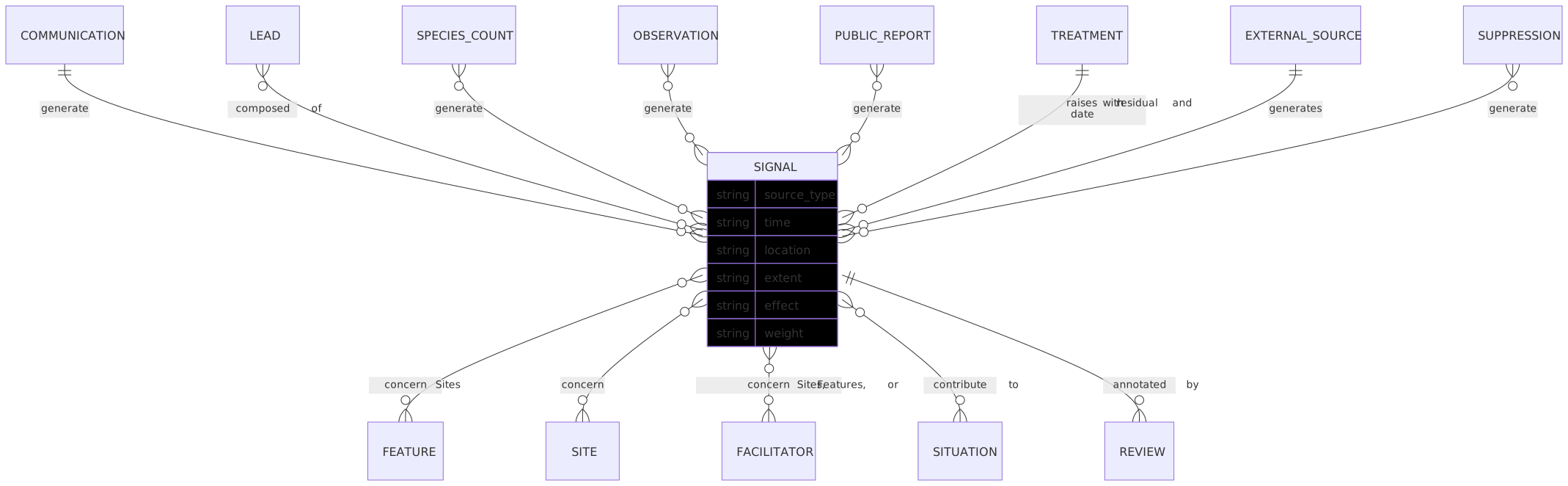
- An Observation may generate Signals (Observation }o──o{ Signal).
- A Species Count may generate Signals (Species Count }o──o{ Signal).
- A Public Report may generate Signals (Public Report }o──o{ Signal).
- A Treatment, read with its residual and the date, may generate Signals (Treatment ||──o{ Signal).
- An external source may generate Signals (External Source ||──o{ Signal).
- A Signal may concern Sites, Features, or Facilitators (Site }o──o{ Signal; Feature }o──o{ Signal; Facilitator }o──o{ Signal).
- A Signal may contribute to one or more Leads (Signal }o──o{ Lead).
- A Signal may contribute to a Situation, individually or through district-defined policy (Signal }o──o{ Situation).
- A Signal may be annotated by Reviews (Signal ||──o{ Review).
Properties
Character — what the indicator is and where it came from.
- Source Type — the kind of material: a measurement, a public report, a detected pattern, or material gathered without access to the subject.
- Time — when the indicator was observed, or the period it refers to. A Signal may describe the past.
- Location — where the indicator applies.
- Extent — how far the indicator reaches.
Interpretation — assigned when the Signal is used, not carried by the Signal itself.
- Effect — whether the Signal supports or opposes a specific hypothesis. Values: Promotive, Suppressive, Contextual.
- Weight — how much the Signal counts in the current evaluation.
Rules
- A Signal is not an Observation. Direct field findings established at the subject are Observations; a Signal is what is reported, remote, inferred, or historical, including what an Observation implies beyond itself.
- Effect is interpretation, not a kind of Signal. One Signal can support one hypothesis and oppose another, so Promotive, Suppressive, and Contextual describe its use in a particular evaluation.
- Interpretation never becomes proof. A Suppressive reading does not establish that no production exists; only direct establishment answers that.
- A Signal is never closed. Its relevance fades as the evidence ages, and the record remains as history.
- Provenance runs forward. An action is traced to the Signals that triggered it by following the records that produced it — Signal to Lead to Assignment to the work and its Observations — and the same chain repeats across generations without the Signal storing back-references.
- A Signal does not require a Site. It may concern an area, a period, or a record that belongs to no single Site.
Relations
Every relation this concept takes part in is drawn on the relationship map.