Lead
Select any passage to ask a question about it or to propose replacement wording.
Lead
Part of Nidus Ontology V3 · Glossary entry · Relationship Map
Definition
A Lead is a geographically specified investigative hypothesis. It names a place worth investigating and what is suspected there, and it directs reconnaissance toward where a source may be found.
Ontological Position
An informational object, and a request for investigation rather than a finding. It says where to look and what is suspected there; nothing about it establishes that production is occurring.
A Lead's identity is the question it asks rather than the evidence behind it. The same Signals may support different Leads where the investigative questions differ, and a Lead raised on judgment alone is no less a Lead. A Situation sets the context a Lead is prioritized within, and an Assignment is the work a Lead produces.
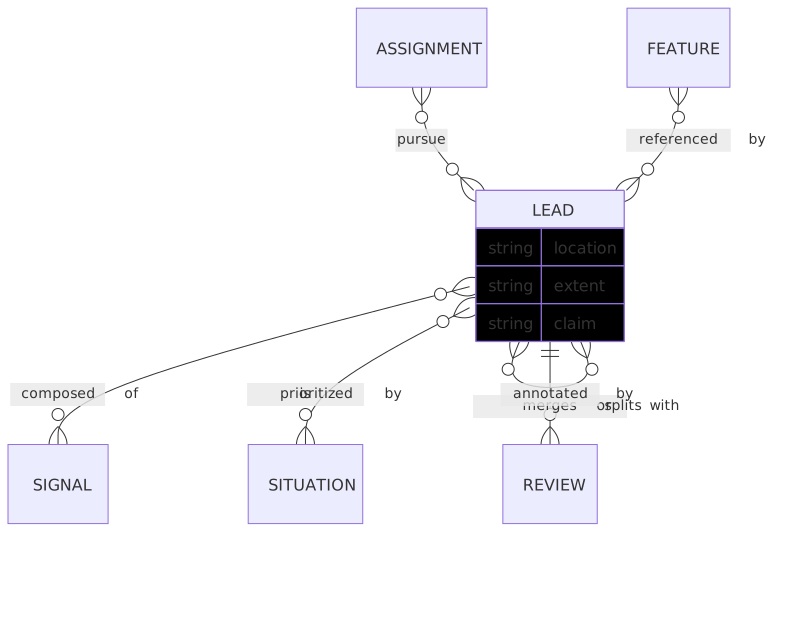
- A Lead may be composed of zero or more Signals (Signal }o──o{ Lead). A Lead with no Signals rests on a planner's judgment and records the reason for it.
- A Lead may merge with one or more other Leads; the merged Lead covers the union of their extents (Lead }o──o{ Lead).
- A Lead may split into several Leads; each covers a section of the original Lead's extent (Lead }o──o{ Lead).
- A Lead may reference the Features at its location (Lead }o──o{ Feature).
- A Lead may generate Assignments (Lead }o──o{ Assignment).
- A Lead's priority may be influenced by a Situation (Lead }o──o{ Situation).
- A Lead may be annotated by Reviews (Lead ||──o{ Review).
Properties
Specification — where the Lead directs attention.
- Location — where investigation should go.
- Extent — how far the hypothesis reaches.
Hypothesis — what is being asked.
- Claim — what is suspected at that location, and what evidence would settle the question.
Rules
- A Lead directs investigation. It asserts a suspicion of production at a place, never that production is occurring.
- A Lead may be raised without Signals when a planner judges that a place warrants investigation. The judgment is recorded, because the record holds no evidence with which to close the question the Lead asks.
- A Lead is not its Signal set. The same Signals may compose distinct Leads, and a Lead retains its own identity when the evidence behind it is restated.
- Merging or splitting a Lead preserves lineage. A merged Lead's location and extent cover the union of its sources; a split Lead's extent is a section of the Lead it came from; every resulting Lead traces to the Leads and Signals it came from.
- A Lead closes when its investigative question is answered, by an Observation, a suppressive Signal, or another artifact that settles it. Closure answers that Lead's question and makes no claim beyond it.
- Closure is final for that Lead. A place that must be investigated again produces a new Lead that may inherit the lineage of former leads.
Relations
Every relation this concept takes part in is drawn on the relationship map.