Route
Select any passage to ask a question about it or to propose replacement wording.
Route
Part of Nidus Ontology V3 · Relationship Map
Definition
A Route is a time-bounded coordination structure that sequences the Assignments given to Technicians over a defined work period. It orders the work of a day, and it exists to carry the Assignments placed in it.
Ontological Position
An operational object: a plan of deployment rather than an action. It performs nothing itself and holds no work of its own; it arranges the work that Assignments already represent. A Route emerges from its Assignments but is represented in its own right, because the sequence and the span of a workday are facts that no single Assignment carries.
A Route exists only for its operational window. A Route may be authored and held before its first Assignment exists, and it means nothing once that window has passed.
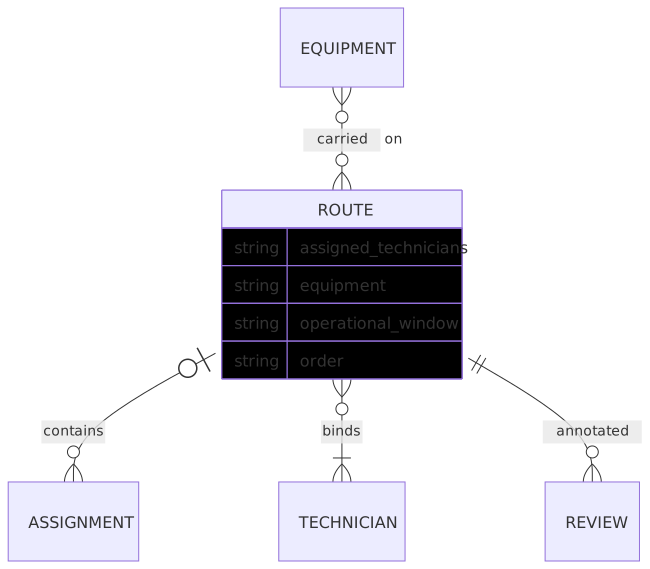
- A Route contains zero or more Assignments, ordered (Route o|──o{ Assignment).
- A Route binds one or more Technicians (Technician |{──o{ Route).
- A Route is issued the equipment that spans its work rather than one Assignment, such as the vehicle used to travel between sites (Route }o──o{ Equipment).
- A Route may be annotated by Reviews (Route ||──o{ Review).
Properties
Who
- Assigned Technicians — the one or more Technicians deployed on the Route.
- Equipment — equipment that spans the whole Route rather than a single Assignment, such as the vehicle used to travel between sites. Equipment issued for one Assignment stays on that Assignment.
Window
- Operational window — the workday or period the Route covers.
Sequence
- Order — the order in which the Route's Assignments are worked.
Rules
- A Route is coordination only. It orders deployment and accounts for it; it performs no operational work.
- A Route binds one or more Technicians. Two Technicians may travel together on the same work, and the Route records who was deployed rather than assuming one person.
- A Route cannot be dispatched with no Assignments. It may be held before its first Assignment exists, and it stops meaning anything once its window has passed.
- An Assignment belongs to at most one Route at a time. Moving work between Routes removes it from the first, so the work is never claimed twice.
- A Route adds no location of its own. Its footprint is the union of its Assignments' extents.
- A completed or cancelled Route is final. Work remaining in the same period is carried by a new Route.
Relations
Every relation this concept takes part in is drawn on the relationship map.