Trap Configuration
Select any passage to ask a question about it or to propose replacement wording.
Trap Configuration
Part of Nidus Ontology V3 · Relationship Map
Definition
A Trap Configuration is a prescription for setting a trap: the trap type, the lure combination, and any settings the trap apparatus itself carries. The district defines the configurations it fields, and a Technician sets a trap to one of them.
Ontological Position
An informational object, and a prescription rather than a thing. It states what should be set — which trap type, with which lures, with the apparatus set how. It is not a trap, holds no equipment, and has no place: the Trap Instance is the act that carries out the prescription, and it records what was actually set.
Two configurations may name the same trap type and differ in their lures or their apparatus settings; they are then different configurations.
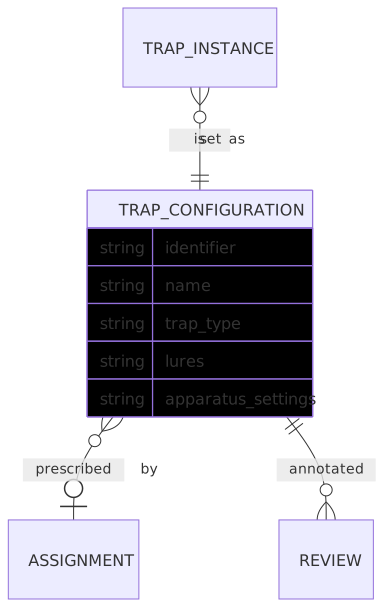
- A Trap Configuration is set as one or more Trap Instances (Trap Configuration ||──o{ Trap Instance).
- A Trap Configuration may be prescribed by an Assignment (Assignment o|──o{ Trap Configuration).
- A Trap Configuration may be annotated by Reviews (Trap Configuration ||──o{ Review).
Properties
Identity
- Identifier — the district's stable identifier for the configuration.
- Name — the district's name for the prescription.
The prescription
- Trap type — the type of trap the prescription calls for.
- Lures — zero or more lures the prescription offers. A lure not listed here is not part of the prescription.
- Apparatus settings — the settings the trap apparatus itself carries, recorded where it has them: a BG-Pro with its lights on, for instance.
Rules
- A configuration is never revised. A change to the trap type, the lures, or the apparatus settings produces a different configuration with its own identity.
- An instance is set as exactly one configuration, and that attribution is permanent. A sample reaches its configuration through the instance.
- The trap type, the lures, and the apparatus settings belong to the configuration. The instance reads them from it and states none of its own.
- The configuration an instance names is the configuration that was set. Where the trap, the lures, or the settings do not match it, the record is wrong and is corrected by naming the configuration actually used.
- Where an Assignment prescribes a configuration, that is what is set. A Technician who sets something different records that configuration at the time of setting. The configuration that was actually set is the truth regardless of what was planned.
- A configuration is not a place. It is possible to have two configurations at the same location.
- Configurations retire rather than disappear. A retired configuration stays readable, and the instances that recorded it keep it.
Relations
Every relation this concept takes part in is drawn on the relationship map.