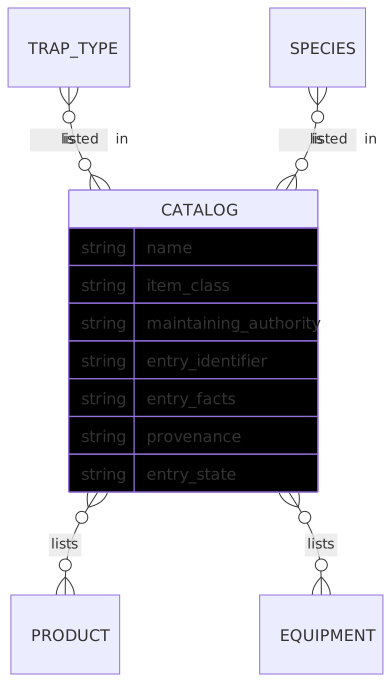
Catalog
Select any passage to ask a question about it or to propose replacement wording.
Catalog
Part of Nidus Ontology V3 · Relationship Map
Definition
A Catalog is a curated list of items of one class, held outside any district, that gives each item a single identity the districts share: a product catalog, an equipment catalog, a trap type catalog, a species catalog. The item is named once, the same way everywhere, and records from different districts are read against one another.
Ontological Position
An informational object, and shared reference data rather than a district's own record. A district adopts a catalog entry and works against it; the entry is curated centrally and no district adds to it directly.
Its purpose is comparability. A district's own vocabulary is free, and the catalog is what keeps that freedom from making two districts' records incomparable: two districts naming the same entry share one identity, and that identity is what a comparison runs on.
A catalog is not what a district works from day to day. Each district keeps its own roster of items it holds, drawn from the catalogs, and a Technician works from that roster. The catalog supplies the shared identity the roster item carries, so two districts recording the same manufactured item record one thing.
An entry is the catalog's record of one item. It carries a stable identifier, the facts the class requires, and the source of each fact. Adoption establishes identity only: what a district did with the item, how much it holds, and who is answerable for it stay on the district's own object.
- A Catalog lists Products (Product }o──o{ Catalog).
- A Catalog lists Equipment (Equipment }o──o{ Catalog).
- A Catalog lists trap types (Trap Type }o──o{ Catalog).
- A Catalog lists species (Species }o──o{ Catalog).
Properties
Identity
- Name — the catalog's name, as the districts and the maintaining authority refer to it.
- Item class — what the catalog lists: Product, Equipment, Trap type, Species.
- Maintaining authority — the body that curates the list and decides what enters it.
Entries
- Entry identifier — the stable identifier the catalog assigns an item, and the identity every district shares for it.
- Entry facts — the properties the class requires of every entry, which vary by catalog: a product's registration number, an equipment item's manufacturer and model.
- Provenance — the source each entry fact is taken from.
- Entry state — Active or Retired.
Rules
- A catalog is shared. It carries no district scope, and no district adds to it directly; a district adopts an entry and may propose an addition for the maintaining authority to decide.
- Two districts adopting one entry share one identity, and that is what makes their records comparable. A district record that matches no entry stays unlinked rather than forced onto one.
- An entry retires rather than disappears, and retirement never alters a fact already recorded against it.
- Each entry fact states its source. A fact derived by inference never passes as one the source states.
- One catalog per class of item, and the class is stated on the catalog.
- Adoption is not ownership. The catalog holds identity and the facts of the item; district use of it is recorded on the district's own object.
Relations
Every relation this concept takes part in is drawn on the relationship map.