Work Order
Select any passage to ask a question about it or to propose replacement wording.
Work Order
Part of Nidus Ontology V3 · Relationship Map
Definition
A Work Order is a standing statement of operational work needed at a place: what should be done, where, and what it requires. It states the need once and persists across the Assignments that carry it out, whether those send a Technician to investigate a Lead or to do work that reduces the population directly.
Ontological Position
An informational object, and the record of a standing need rather than a unit of execution. An Assignment is one execution of a Work Order; the same Work Order may be executed repeatedly, and it remains in force between those executions.
A Work Order is not an Assignment awaiting a Technician. It states what the work is; the Assignment states who does it, when, and under what conditions.
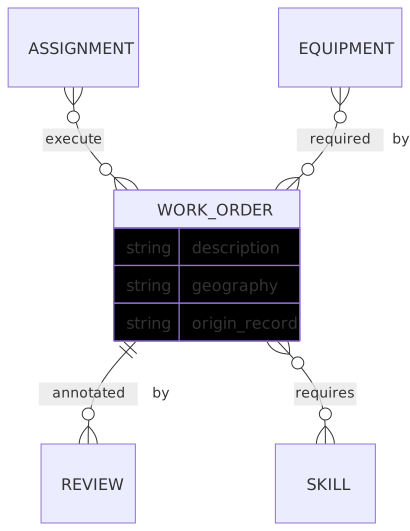
- A Work Order may generate Assignments, including repeated executions of the same work (Work Order }o──o{ Assignment).
- A Work Order may originate from an Assignment whose work revealed a need outside its scope (Assignment }o──o{ Work Order).
- A Work Order may require equipment beyond the standard kit (Work Order }o──o{ Equipment).
- A Work Order may require skills held by specific Technicians (Work Order }o──o{ Skill).
- A Work Order may be annotated by Reviews (Work Order ||──o{ Review).
Properties
Need
- Description — what work is required, and the condition that requires it.
- Geography — the area the work concerns. It may be unset until the work is planned, where the location is settled.
Origin
- Origin record — the record the need was identified from, where one exists.
Rules
- A Work Order causes no action. Execution begins when an Assignment is made from it.
- A Work Order remains in force until it is cancelled with a stated reason. An Assignment does not close it.
- An Assignment carries the Work Order's description, geography, equipment, and skills rather than copying them, so repeated executions inherit one statement of the work.
- A Work Order may be recurring. The same need may be executed many times, and each execution is its own Assignment with its own outcome.
- A Work Order may arise from an Assignment that met a need beyond its own scope, and the originating relation is recorded so that work found in the field is not lost.
Relations
Every relation this concept takes part in is drawn on the relationship map.