Contact
Select any passage to ask a question about it or to propose replacement wording.
Contact
Part of Nidus Ontology V3 · Glossary entry · Relationship Map
Definition
A Contact is a person associated with one or more Sites who holds, manages, or speaks for the property there: an owner, a tenant, a property manager, a maintenance lead, a farmer, an irrigation manager, or an association representative. The Contact is whom the district communicates with, and whose consent allows work at the Site.
Ontological Position
A real-world entity, represented rather than created by Nidus. The person exists independently of any Communication, and their relevance to a Site may outlast every event that named them.
A Contact is the human relationship between a person and a Site. It is not a role in Nidus, and it does no operational work: a Contact cannot alter a Feature, a Lead, an Assignment, or a Signal. A Technician is district personnel who act; a Contact is the party the district acts with.
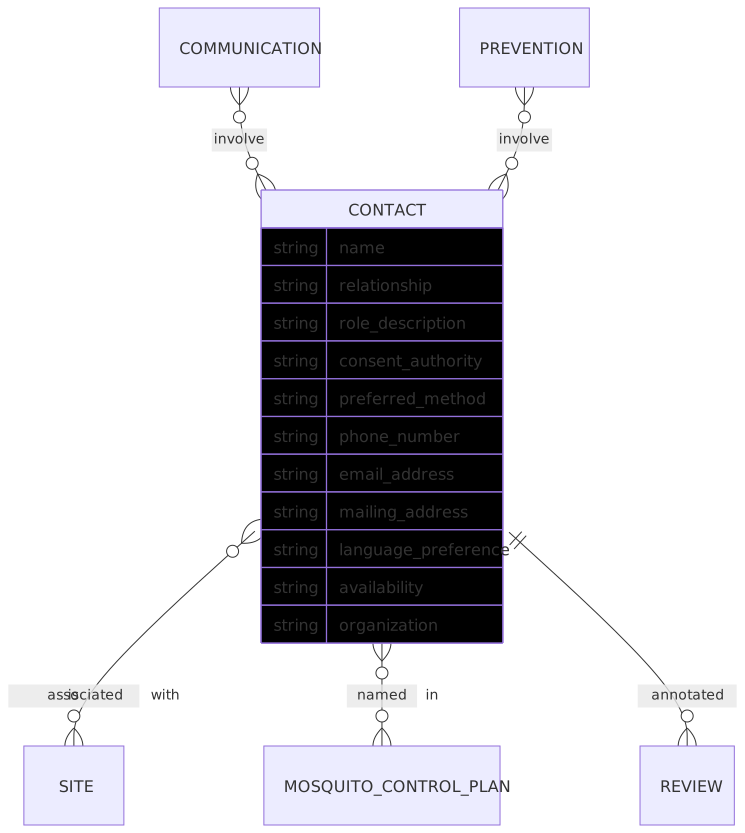
- A Contact is associated with one or more Sites (Site }o──o{ Contact).
- A Contact may take part in Communications (Contact }o──o{ Communication).
- A Contact may be named in a Mosquito Control Plan and carry responsibility under it (Contact }o──o{ Mosquito Control Plan).
- A Contact may be annotated by Reviews (Contact ||──o{ Review).
Properties
Identity
- Name — the person's name. One person is one Contact, whatever they are called at each Site.
Relationship to Site
- Relationship — how the Contact stands to the Site: Owner, Tenant, Property Manager, Maintenance Staff, Association Representative, Farmer, Irrigation Manager, or Responsible Party.
- Role description — a narrative of the relationship, where the category alone is not enough.
- Consent authority — whether this Contact may permit access or work at the Site.
Communication
- Preferred method — phone, text, email, mail, or in person.
- Phone number — the number to reach the Contact on.
- Email address — the mailbox to reach the Contact at.
- Mailing address — the postal address, where one is used.
- Language preference — the language to communicate in.
- Availability — when the Contact can be reached.
Affiliation
- Organization — the body the Contact belongs to or represents, where one applies: an irrigation district, a city department, an association, a management company, an agricultural company, or a household.
Rules
- A Contact is a person, not a role. One person is one Contact across the Sites they are associated with, and their relevance persists across seasons.
- A Contact does no operational work. Nothing a Contact does can change a Feature, a Lead, an Assignment, or a Signal.
- Consent authority belongs to the Contact's relationship with a Site. Where an operational act needs permission, the permission comes from a Contact who holds it for that Site.
- A Contact's relationship may change or end without losing history. Records that name the Contact keep naming them, and the change is recorded as a change of relationship.
- Where an interaction has no identifiable person behind it, the record names the Site rather than inventing a Contact.
Relations
Every relation this concept takes part in is drawn on the relationship map.