Trap Instance
Select any passage to ask a question about it or to propose replacement wording.
Trap Instance
Part of Nidus Ontology V3 · Relationship Map
Definition
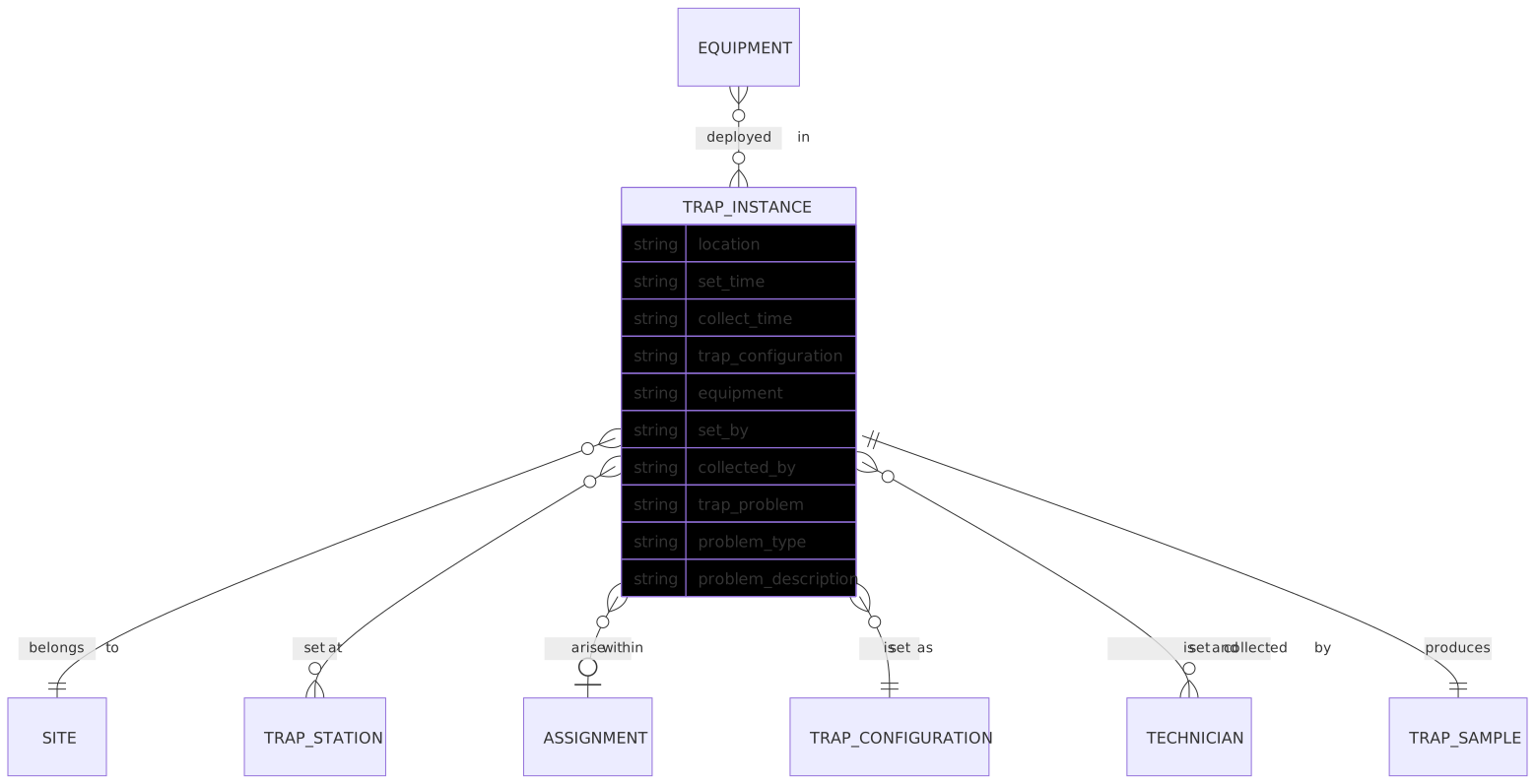
A Trap Instance is one instance of the trapping act: the place the trap was set, the Trap Configuration it was set as, the equipment deployed, the Technicians who set and collected it, the set and collect datetimes, and any trap problem encountered. It produces one Trap Sample.
Ontological Position
An operational object, and an act rather than an asset. It records what was done, where, over what interval, by whom and with what, and it produces the physical sample the lab later examines.
A Trap Instance is set as exactly one Trap Configuration. The district defines the configurations it accepts; the Technician sets the trap to one of them and the instance records which. Everything the configuration states is read through it and restated nowhere.
The equipment is Equipment, held in inventory like any other district item. The configuration names the type of device, and the instance records the items actually deployed.
The trapping interval is the sampling effort, derived from the set and collect datetimes. It is read from those two times and recorded nowhere else.
- A Trap Instance belongs to exactly one Site (Site ||──o{ Trap Instance).
- A Trap Instance may be set at one Trap Station (Trap Station }o──o{ Trap Instance).
- A Trap Instance may arise within an Assignment (Assignment o|──o{ Trap Instance).
- A Trap Instance is set as exactly one Trap Configuration (Trap Configuration ||──o{ Trap Instance).
- A Trap Instance is set with one or more items of Equipment (Trap Instance }o──o{ Equipment).
- A Trap Instance is set and collected by Technicians (Technician }o──o{ Trap Instance).
- A Trap Instance produces exactly one Trap Sample (Trap Instance ||──|| Trap Sample).
Properties
The act
- Location — the coordinates captured when the trap was set, recorded on every instance.
- Set time — when the trap was set.
- Collect time — when the trap was collected.
Setup
- Trap Configuration — the accepted configuration the instance was set as.
- Equipment — the items deployed for the set.
People
- Set by — the Technician or Technicians who set the trap.
- Collected by — the Technician or Technicians who collected it.
Trap problem
- Trap problem — whether the set met a problem that makes the sample unusable for metrics. Values: Yes, No.
- Problem type — the kind of problem, taken from Trap Problem, where one occurred.
- Problem description — the account of what happened, where one occurred.
Rules
- A Trap Instance holds the parameters of the act. The catch belongs to the Trap Sample, and the interval is derived from the set and collect times.
- Every instance records its exact coordinates, at a station or away from one. An instance stating no coordinate is incomplete and stays out of every metric until corrected.
- An instance does not depend on a station. An off-station instance is ordinary work, and it forms no series rather than awaiting a station.
- An instance is set as exactly one Trap Configuration, and the configuration is the whole of the setup: the trap type, the lures, and the apparatus settings are read from it and are never restated on the instance.
- The equipment deployed is recorded on the instance. Trap hardware is Equipment like any other district item, and it is tracked in inventory under its own identity.
- One instance yields exactly one Trap Sample. A rotator trap is several instances, each with its own shorter interval.
- Setting and collecting are separate visits, and different Technicians may perform them. One instance may be referenced by the Assignment that set it and by the Assignment that collected it.
- A trap problem is recorded on the instance when the trap is collected: the flag, the type, and the description. A flagged instance is non-comparable, its sample is excluded from metric calculations, and the record is kept.
- An instance's Site is derived and never chosen: the station's Site where a station is named, otherwise the nearest Site within the proximity threshold. An unresolved Site is surfaced for Review.
- One item of Equipment belongs to at most one open instance at a time. An item that is set and not yet collected is in one place.
Relations
Every relation this concept takes part in is drawn on the relationship map.