Site
Select any passage to ask a question about it or to propose replacement wording.
Site
Part of Nidus Ontology V3 · Glossary entry · Relationship Map
Definition
A Site is a geographic area under a single ownership, control, or responsibility, where mosquito-related activities take place. It is the place where Features and Facilitators are found.
Ontological Position
A real-world entity and a social and legal unit. It exists whether or not Nidus represents it, and its identity persists while its boundary, address, and use are refined.
A Site is the level at which responsibility is held. A Feature can be producing mosquitoes, but it is the Site that has an owner, an access arrangement, and a standing that the district acts on.
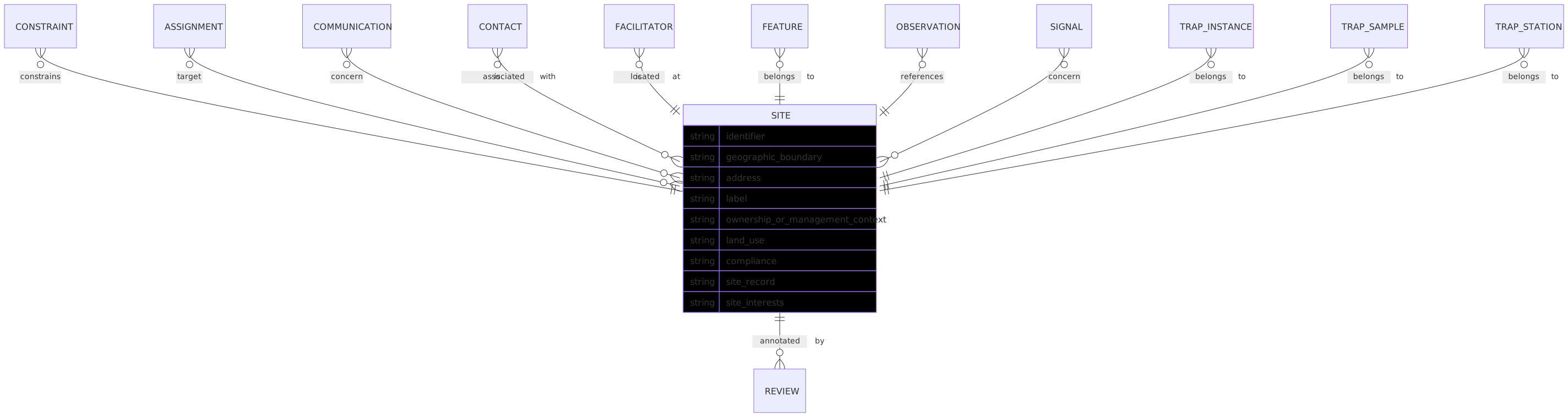
- A Site contains Features (Site ||──o{ Feature).
- A Site contains Facilitators (Site ||──o{ Facilitator).
- A Site has zero or more Contacts, and a Contact may serve several Sites (Site }o──o{ Contact).
- A Site may be annotated by Reviews (Site ||──o{ Review).
- A Site may be the subject of Observations (Site ||──o{ Observation).
- A Site may raise Signals (Site }o──o{ Signal).
Properties
Identity
- Identifier — the only thing that identifies a Site. The boundary, address, and label are attributes and may all change.
Location
- Geographic boundary — the area the Site covers, which may be refined over time.
- Address — present where one exists, optional in every case, never identity.
- Label — the name used to refer to the Site.
Governance
- Ownership or management context — who is responsible for the Site.
- Land Use — how the land is used. Value set of 8, defined in Land Use.
- Compliance — whether known mosquito-producing conditions are being addressed under an authorized plan or process. Values: In compliance, Out of compliance.
Record
- Site Record — every Feature, Facilitator, Constraint, Treatment, and other record made at the Site, held at the place it was made. It only grows.
Derived
- Site Interests — for each kind of Feature, Facilitator, or Constraint recorded at the Site, the number of instances and the probability that each persists. Derived from the Site Record and revised as records land and as probability decays.
Rules
- A Site's identity is its identifier alone. Boundary, address, and label may be corrected or refined, and none of them identifies it.
- A Site is not a parcel. Parcel data may inform the boundary, and a Site need not correspond to exactly one parcel; the Site is the real-world unit and the parcel is reference data.
- An address is optional. A Site may be recorded as geometry with no address at all.
- Compliance is derived, never set. It follows from the Site's Features, its control plans, its abatement communications, and its constraints.
- A Site with a Feature producing mosquitoes is Out of compliance unless an active plan or an active abatement applies to it.
- A Site stays Out of compliance where the district has Signals of a possible producing condition, access has been refused, and production can be neither confirmed nor ruled out. It remains so until the owner grants access or supplies evidence that no producing condition exists.
- Compliance informs planning and never triggers action by itself, and it never alters a Feature's recorded condition.
- Site Interests is derived, never set. For each kind recorded at the Site it reports a count and a persistence probability, and it changes no object. Nothing establishes it and nothing withdraws it: recording an instance adds evidence, and time lowers the probability.
Relations
Every relation this concept takes part in is drawn on the relationship map.