Feature
Select any passage to ask a question about it or to propose replacement wording.
Feature
Part of Nidus Ontology V3 · Glossary entry · Relationship Map
Definition
A Feature is a real-world mosquito-relevant object located within a Site that holds or can hold water and support mosquito production, as one visit found it. Pools, ponds, storm drains, irrigation structures, containers, and wetlands are Features. A Feature is recognized in the field and exists independently of Nidus; the record of it is scoped to the visit that found it.
Ontological Position
A Real World entity: it exists whether or not Nidus represents it, and it is not a record of work — Observations, Inspections, and Treatments are the records, and they refer to the Feature.
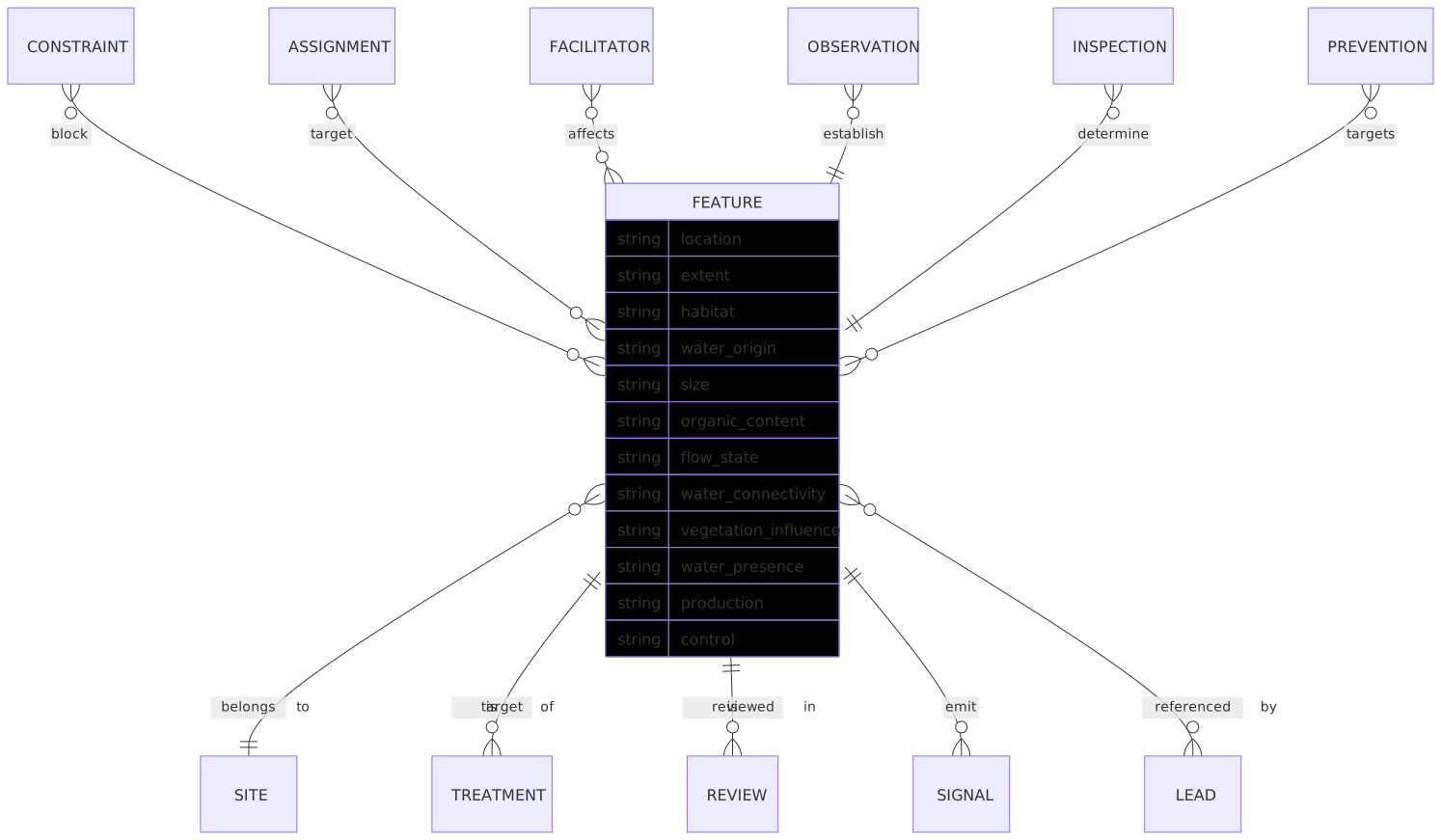
- A Feature belongs to exactly one Site (Site ||──o{ Feature).
- Observations establish a Feature and state its properties (Observation ||──o| Feature).
- Inspections determine a Feature's production status (Feature ||──o{ Inspection).
- A Feature may be the target of Treatments (Feature ||──o{ Treatment).
- A Feature may be subject to Reviews (Feature ||──o{ Review).
- A Feature may emit Signals (Feature ||──o{ Signal).
- A Feature may be referenced by Leads (Lead }o──o{ Feature).
- A Feature may be the target of an Assignment (Assignment }o──o{ Feature).
Properties
Every property record carries the Observation, Inspection, or Treatment that produced it.
Location and extent
- Location — where the Feature is.
- Extent — how far it reaches.
Classification — what the Feature is. Established by Observation.
- Habitat — the class of water-holding object; defining. Value set of 47, defined in Habitat.
- Water Origin — the pathway by which water arrives and keeps arriving. Value set of 17, defined in Water Origin.
Condition — how the Feature is found. Recorded by Observation.
- Size — the surface area and volume of the water the Feature holds, not the footprint of the object.
- Organic Content — the biological material in the water. Value set of 3, defined in Organic Content.
- Flow State — the rate and consistency of water movement. Value set of 3, defined in Flow State.
- Water Connectivity — the degree to which water, larvae, or eggs can move between this Feature and others without adult dispersal. Value set of 4, defined in Water Connectivity.
- Vegetation Influence — how vegetation interacts with the Feature. Value set of 4, defined in Vegetation Influence.
Assessments — what the water was doing at the time of the visit.
- Water Presence — whether the Feature holds water now. Value set of 3, defined in Water Presence. Recorded by Observation.
- Production — whether the Feature is currently generating mosquitoes. Value set of 3, defined in Production. Established only by Inspection.
- Control — the operational expectation of suppression from the residual duration of the last applied Product. Value set of 3, defined in Control. Derived from Treatment, not recorded directly.
Rules
- A Feature record states one object as one visit found it. A later visit that finds the object creates a new Feature.
- Habitat is defining. A Feature records one Habitat. Correcting a Habitat recorded in error is a Review correction on the record, not a change of the object.
- Classification changes only through an Observation. A Signal may suggest a change but cannot enact one.
- Production is established by an Inspection, or by an Observation that the Feature is Dry. A Dry Feature is Not producing; a Wet Feature may be either Producing or Not producing.
- Control expresses expectation, not production truth.
Relations
Every relation this concept takes part in is drawn on the relationship map.